Analyzing Instrument-Rated Sites for Revenue Loss Prevention
A single defective current transformer can cost a utility tens of thousands of dollars per year per site. CT-rated site testing identifies these defects before they drain commercial and industrial billing. This guide explains the defects, the inspection methods that detect them and how to prioritize testing without adding workload.
Get the Full White PaperWhy CT-Rated Meter Sites Quietly Bleed Utility Revenue
Commercial and industrial accounts represent a small share of utility customers but generate roughly 80 percent of utility revenue. Most of these high-value accounts are measured with CT-rated installations, where a current transformer (CT) steps down the primary current to a level the meter can read. When the CT or its wiring develops a defect, the meter still records a number, but the number is wrong.
CT-rated site testing exists because the defects that cause revenue loss are almost always invisible during normal operation. A loose connection, a reversed CT polarity or a mislabeled nameplate produces no alarm, no outage and no customer complaint. The site keeps running. The bill keeps going out. The utility keeps losing money for as long as the defect remains undetected.
The Probewell Lab white paper "Analyzing Instrument-Rated Sites for Revenue Loss Prevention" documents the six defect types and the five inspection methods that detect them. This pillar page summarizes the white paper findings and links to the full document for technical readers who need the complete formulas, scenarios and cost tables.
How Much Does a Single CT Defect Actually Cost a Utility?
CT-rated revenue loss can be calculated directly from three inputs: the lost watts per phase at the meter, the CT ratio multiplier and the energy price per kilowatt-hour. The Probewell Lab white paper uses a U.S. EIA reference price of $0.1289 per kilowatt-hour (June 2022) and a benchmark 400:5 CT installation drawing 600 amps at 240 volts.
The same benchmark installation produces very different losses depending on the defect. Each defect below is shown with its annual cost, followed by the hourly calculation that produces that figure. All scenarios apply to a single CT-rated site operating an 8-hour day, 5-day week.
Loose connection on one phase
$1,291 per year
 Source: Probewell Lab white paper, page 9. Based on a 60 W per-phase reduction at the meter, multiplied by CT ratio 80 and $0.1289 per kWh.
Lost Revenue Calculation per Hour
| 1 - Benchmark installation | 1,800 W |
| 2 - Defective installation | 1,740 W |
| Difference | 60 W |
| Ratio 400:5 | × 80* |
| 3 - Lost | 4.8 kW |
| Average cost | × $0.1289 / kWh** |
| Total lost per hour | $0.62 |
Wrong CT ratio (400:5 nameplate on a 1000:5 transformer)
$23,244 per year (60 percent revenue loss)
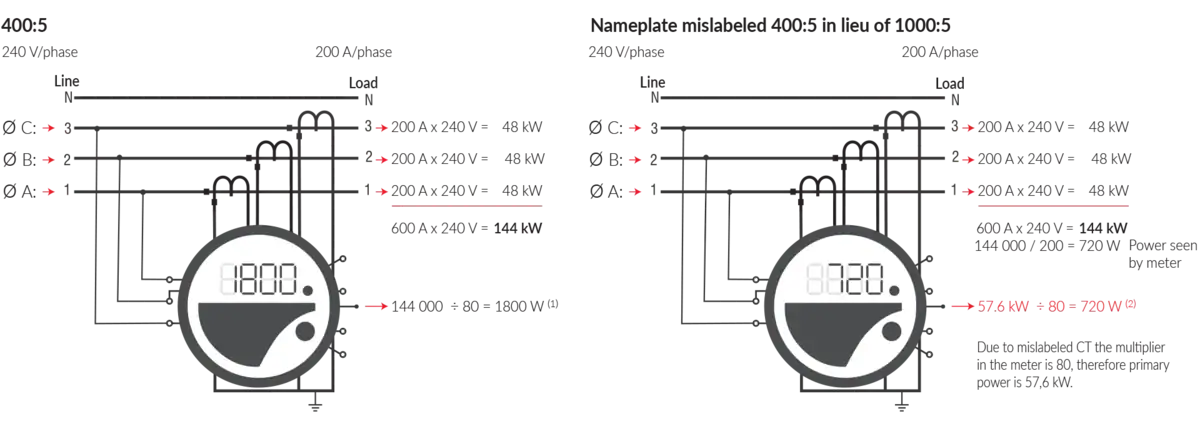 Source: Probewell Lab white paper, page 13. The meter applies an 80 multiplier when it should apply 200, undercharging the customer by 60 percent.
Lost Revenue Calculation Over Time Due to a Wrong Ratio
| Proper labeling 400:5 | 1,000:5 mislabeled as 400:5 | |
|---|---|---|
| Expected / actual secondary power | 1,800 W | 720 W |
| Ratio multiplier | × 80* | × 80* |
| Real / displayed consumption | 144 kW | 57.6 kW |
| Average cost | × $0.1289 / kWh** | × $0.1289 / kWh** |
| Energy registered | 1,152 kWh | 460.8 kWh |
| Total per hour | $18.56 | $7.42 |
| Total lost per hour (proper minus mislabeled) | $11.14 | |
Reversed CT polarity on one phase
$25,827 per year
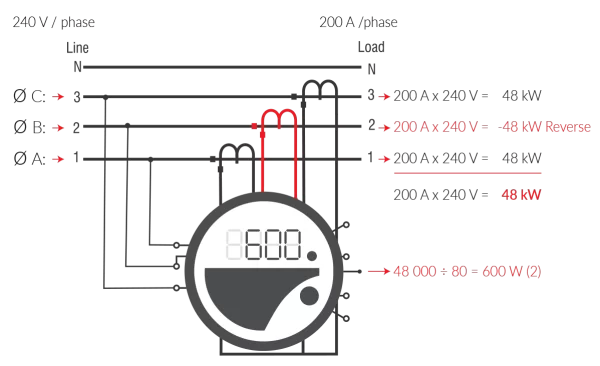 Source: Probewell Lab white paper, page 11. One inverted phase cancels the positive reading of an adjacent phase, costing up to two-thirds of the site revenue.
Lost Revenue Calculation per Hour
| 1 - Benchmark installation | 1,800 W |
| 2 - Defective installation | 600 W |
| Difference | 1,200 W |
| Ratio 400:5 | × 80* |
| 3 - Lost | 96 kW |
| Average cost | × $0.1289 / kWh** |
| Total lost per hour | $12.37 |
* Ratio between the primary current and the secondary current.
** Source: U.S. EIA, Average Price of Electricity to Ultimate Customers by End-Use Sector, June 2022 ($0.1289 cents per kilowatt-hour).
*** A standard 8-hour day and 5-day week was used in these calculations. The standard is meant to average energy consumption so results are not artificially inflated. Commercial and industrial customers have different peaks of consumption within a day. To know the weekly cost for a company that runs 24/7, use the following formula: (cost per day × 3) × 7 days.
Losses scale with the size of the installation. A 2,000 amp service at the U.S. industrial average rate produces proportionally higher annual losses than the benchmark used in the white paper. Utilities with large industrial accounts can lose six-figure sums per year when multiple defects remain undetected across a portfolio.
The 6 Most Common CT Defects That Drain Utility Revenue
CT-rated site testing targets six defect types documented in the Probewell Lab white paper. Each defect produces a distinct meter behavior, and each defect is detectable with one or more of the five inspection methods covered in the next section.
Loose Connections in CT-Rated Installations
Loose connections occur when terminal hardware loosens over time through repeated heating and cooling cycles or through corrosion. Loose connections raise impedance in the secondary circuit, which reduces the current the meter sees. The meter under-records consumption and the utility under-bills the customer.
Loose connections are detectable with a power quality test that compares per-phase secondary current against expected values, or with an admittance test that flags abnormal impedance. Loose connections also create arcing risk inside the CT cabinet, which is a safety concern in addition to a revenue concern.
Incorrectly Installed Current Transformer
An incorrectly installed current transformer is wired with reversed polarity, so the meter reads the affected phase as if the customer is generating electricity rather than consuming it. The reversed phase produces a negative power reading that partially cancels the positive readings of the adjacent phases.
An incorrectly installed CT on a three-phase site can cost up to two-thirds of the revenue at that location. The defect is detectable with a power quality test that displays per-phase phasor vectors and identifies any phase rotated 180 degrees from its expected position.
Shorted Current Transformer
A shorted current transformer has an internal short between secondary turns, which prevents the meter from receiving current information for that phase. The meter records no consumption on the shorted phase, resulting in approximately one-third revenue loss on a three-phase site.
A shorted CT is detectable with a power quality test (zero secondary current on the affected phase), a ratio test (infinite ratio reading because secondary current is missing) or an admittance test (abnormally high millisiemens reading because admittance is the reciprocal of impedance).
Degrading Current Transformer
A degrading current transformer has accumulated internal impedance from overheating, mechanical stress or insulation breakdown. A degrading CT does not fully fail, but it produces inaccurate secondary current under load, which translates directly into billing errors. A degrading CT may also fail open at any time, which creates a dangerous voltage spike at the meter.
A degrading CT is detectable with a CT secondary burden test that verifies whether the transformer can supply rated current into its specified burden while maintaining stated accuracy. An admittance test against the original installation benchmark also flags gradual degradation.
Open Current Transformer
An open current transformer has lost continuity in its secondary winding. When primary current still flows through an open CT, the secondary voltage rises uncontrollably, potentially exceeding 6,000 volts at the meter. An open CT is the most dangerous of the six defects, creating arc flash risk and equipment damage.
An open CT is detectable with a power quality test (no secondary current) and confirmed with an admittance test (extremely low admittance because impedance is near infinite). Field technicians should check secondary current at the meter base before removing the meter to prevent an unsafe open-CT condition.
Wrong CT Ratio on the Nameplate
A wrong CT ratio occurs when the transformer nameplate identifies a ratio that does not match the actual installed transformer. A nameplate marked 400:5 on a transformer that is actually 1000:5 causes the meter to apply an 80 multiplier when the correct multiplier is 200. The customer is undercharged by 60 percent of consumption.
A wrong CT ratio is detectable with a primary and secondary analysis (ratio test) that injects a primary current and measures the induced secondary current. The Probewell Lab white paper documents a $23,244 annual loss for a single CT-rated site with this defect at the benchmark consumption level.
The 5 Inspection Methods That Detect CT-Rated Revenue Loss
CT-rated site testing uses five complementary inspection methods. No single test detects every defect, which is why the Probewell Lab white paper recommends combining methods in a single site visit. The table below maps each method to the defects it detects.
| Factor Leading to Revenue Loss |  Safety and Visual Safety and Visual |
 Power Quality Power Quality |
 Primary / Secondary Primary / Secondary |
 Secondary Burden Secondary Burden |
 Admittance Admittance |
|---|---|---|---|---|---|
| Incorrectly installed current transformer | ✓ | ✓ | ✓ | ✓ | |
| Shorted CT secondary | ✓ | ✓ | ✓ | ✓ | ✓ |
| Degrading CT secondary | ✓ | ✓ | ✓ | ✓ | |
| Open CT secondary | ✓ | ✓ | ✓ | ✓ | ✓ |
| CT nameplate error * | ✓ | ✓ | ✓ | ||
| High burden | ✓ | ✓ | ✓ | ||
| CT magnetization | ✓ | ✓ | ✓ | ✓ | |
| Sag/Swells | ✓ | ||||
| Harmonic distortion | ✓ | ||||
| Outage | ✓ | ✓ | |||
| Spikes and transient voltage | ✓ | ||||
| Undervoltage/overvoltage | ✓ | ✓ | |||
| Voltage/current imbalance | ✓ | ||||
| Voltage/current fluctuations | ✓ | ||||
| Poor power quality | ✓ | ||||
| Power theft | ✓ | ✓ |
* A CT nameplate error could be the wrong ratio, the wrong accuracy class and/or the wrong maximum burden.
Safety and Visual Inspection
Safety and visual inspection is the first inspection method at every CT-rated site visit. Visual inspection detects loose hardware, corrosion, signs of arcing, tampering and incorrect wiring routing before any electrical test begins. Visual inspection also confirms that the installed CT nameplate matches the utility's records, which prevents wrong-ratio billing errors.
Power Quality Test
The power quality test measures per-phase secondary voltage and current, displays phasor vectors and computes power factor and harmonic content. The power quality test detects incorrectly installed CTs (phase rotated 180 degrees), shorted CTs (zero current), open CTs (no current with high voltage stress) and degrading CTs (abnormal phase angle or current amplitude).
Primary and Secondary Analysis (CT/PT Ratio)
Primary and secondary analysis (the CT/PT ratio test) injects a known primary current and measures the secondary current to verify that the actual transformer ratio matches the nameplate. The ratio test detects wrong-ratio nameplates, confirms correct polarity and identifies multi-tap transformers wired to the wrong tap.
CT Secondary Burden Test
The CT secondary burden test injects a resistive load into the secondary loop and measures the current drop across the injection points. The burden test verifies that the CT can supply rated secondary current into its specified burden (typically expressed as 0.3 B 0.5, where B 0.5 is the maximum burden in ohms). A failed burden test indicates a degrading or undersized CT that will produce billing errors under load.
Admittance Test
The admittance test injects an audio frequency into the CT secondary and measures the induced current and voltage to compute admittance in millisiemens. Admittance is the reciprocal of impedance, so a high admittance reading indicates internal shorts and a low admittance reading indicates an open or damaged circuit. The admittance test is the only method that establishes a CT-specific baseline at installation that can be compared over time to detect gradual degradation.
How to Prioritize CT-Rated Site Inspections Without Adding Workload
Most utility teams cannot inspect every CT-rated site every year. The Probewell Lab white paper recommends a prioritization framework that focuses inspections on the sites with the highest revenue exposure and the longest gap since last inspection.
Priority 1: large commercial and industrial accounts. CT-rated sites serving large industrial loads carry the largest revenue exposure per defect. A 2,000 amp service with a reversed CT can lose tens of thousands of dollars per year. Annual inspection is justified at this level.
Priority 2: sites with no admittance baseline. A CT installed before admittance baselines became standard practice cannot be compared against a known-good reading. These sites benefit from an admittance test on the next routine visit, which establishes a baseline for all future comparisons.
Priority 3: sites approaching 10 years since last inspection. CT degradation is gradual but cumulative. A CT that has not been inspected in 10 years has a higher probability of harboring an undetected defect than a CT inspected within the last 3 years.
Priority 4: sites with billing anomalies flagged by the customer information system. Sudden drops in billed consumption without a corresponding change in customer operations are a strong signal of a developing CT defect.
The Probewell Lab white paper also recommends conducting CT-rated site testing from the meter base rather than from the test switches. Meter-base testing reduces handling errors, exposes fewer connections to the technician and tests the entire system from the same vantage point the meter uses. Meter-base testing keeps the meter out of service for no more than 20 minutes per visit, which is shorter than most test-switch sequences.
Frequently Asked Questions About CT-Rated Site Testing
What is CT-rated meter testing?
CT-rated meter testing is the diagnostic inspection of current-transformer-rated electrical service installations to verify that the meter receives accurate secondary current and voltage signals. CT-rated meter testing combines visual inspection, power quality measurement, primary and secondary ratio analysis, burden testing and admittance testing to identify defects that cause billing errors.
What is a CT-rated site tester?
A CT-rated site tester is a portable diagnostic instrument that performs the five inspection methods required to verify a CT-rated installation. A CT-rated site tester combines power quality measurement, ratio testing, burden testing and admittance testing in a single unit that connects to the meter base or the test switches.
How much revenue can one defective CT cost a utility?
One defective CT can cost a utility from approximately $1,300 per year for a loose connection to more than $25,800 per year for a reversed CT polarity, based on the Probewell Lab white paper benchmark of a 400:5 CT installation at the U.S. EIA average industrial rate of $0.1289 per kilowatt-hour (June 2022). Losses scale with installation size and consumption.
How often should CT-rated sites be inspected?
The Probewell Lab white paper recommends prioritizing CT-rated site inspection by revenue exposure and time since last inspection rather than applying a single fixed interval. Large commercial and industrial accounts benefit from annual inspection. Sites with no admittance baseline benefit from a baseline test on the next routine visit. Sites approaching 10 years without inspection should be scheduled for testing.
Why is testing from the meter base better than testing from the test switches?
Meter-base testing reduces the number of connections the technician must handle, which lowers the risk of crossing wires, mismatching phases or reversing polarities. Meter-base testing also lets the tester see exactly what the meter sees, which improves data accuracy. The Probewell Lab white paper documents that meter-base testing keeps the meter out of service for no more than 20 minutes per site visit.
What is the difference between a CT burden test and a CT admittance test?
A CT burden test injects a resistive load into the secondary circuit at rated secondary current to verify that the CT can supply current into its specified burden without losing accuracy. A CT admittance test injects an audio frequency at low secondary current to measure the reciprocal of impedance, which detects internal shorts and damaged windings. Burden testing and admittance testing complement each other and detect different failure modes.
Can CT-rated site testing detect power theft?
CT-rated site testing detects power theft through visual inspection (signs of tampering, bypass wiring, broken seals) and power quality measurement (anomalous current or voltage patterns inconsistent with the customer's declared load). Power theft is a common cause of unexplained revenue loss at CT-rated sites and is one of the inspection categories listed in the Probewell Lab white paper.
What does Probewell Lab recommend for utilities starting a CT-rated inspection program?
Probewell Lab recommends starting CT-rated inspection programs with the highest-revenue commercial and industrial accounts, establishing admittance baselines at every site visit and choosing a CT-rated site tester that performs all five inspection methods in a single tool to reduce technician training time and on-site duration. The full Probewell Lab white paper documents the methodology in detail.
Download the Full White Paper on CT-Rated Revenue Loss Prevention
The 28-page Probewell Lab white paper expands every section on this page with worked numerical scenarios, wiring diagrams, phasor diagrams and the complete cost-of-loss tables. The white paper includes the detailed inspection method matrix, the safety procedures for handling open CTs and the operational case for testing from the meter base.
Provide your work email and we will send you the white paper directly. Probewell Lab does not share contact information.
Talk to a Probewell Lab Specialist About CT-Rated Site Testing
Probewell Lab manufactures the ST-3/XT3 transformer-rated site tester, which performs the five inspection methods covered in the white paper in a single field unit. Probewell Lab specialists can walk through your current inspection workflow, identify gaps and recommend a path forward that fits your team and your budget.
Learn About ST-3/XT3